Project Overview
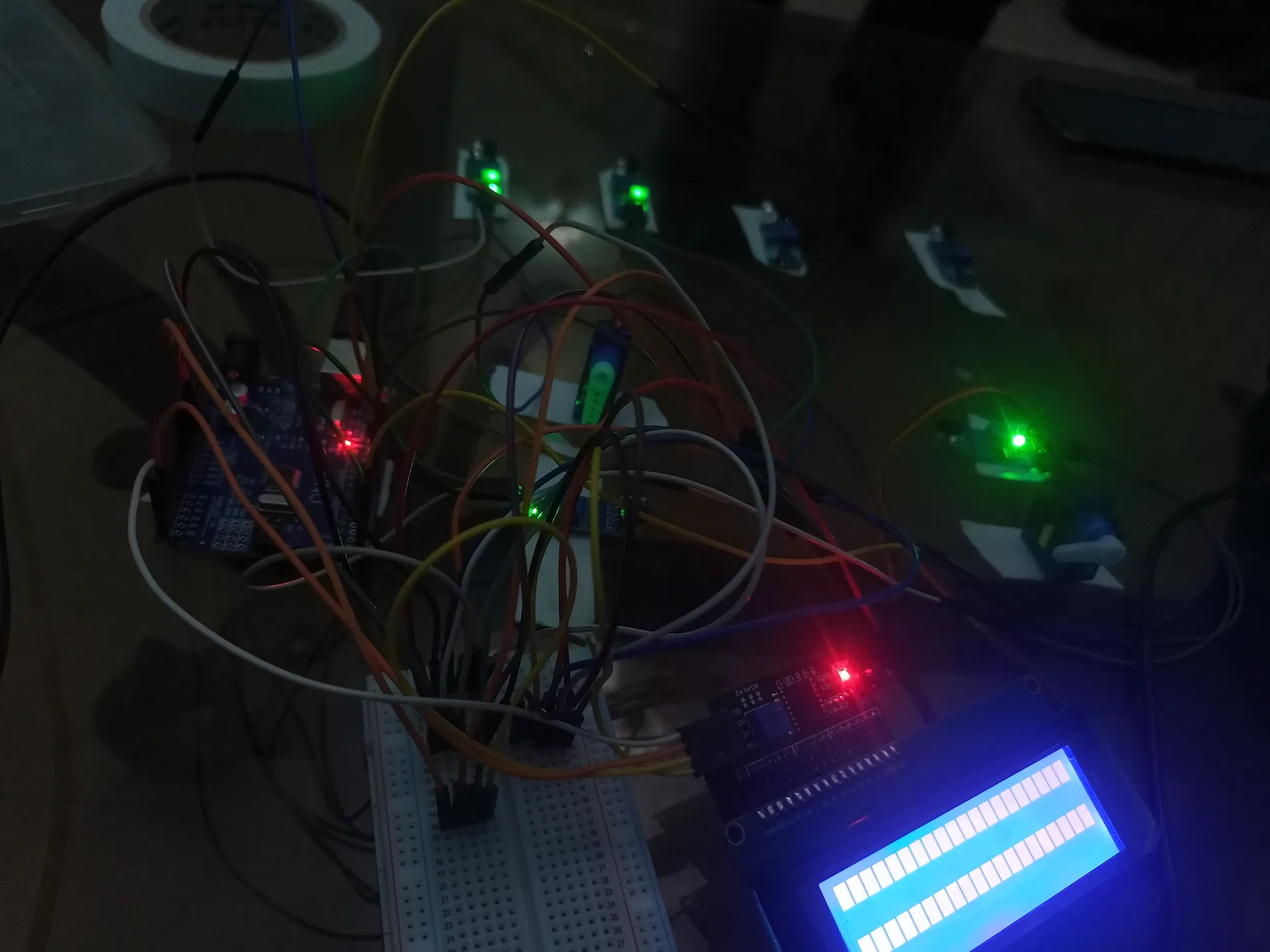
The Intelligent Vehicle Parking Management System (IVPMS) is an IoT-based solution built to automate parking slot detection, gate control, and real-time monitoring. The system uses IR sensors to detect vehicle presence across 4 slots, servo motors to control entry and exit gates, and an ESP8266 (NodeMCU) to transmit live data to the Arduino IoT Cloud dashboard. A 20×4 I2C LCD on-site displays slot status in real time. This was a group project for the AI & IoT course (ME-438) at NED University. My role covered complete hardware assembly — wiring the Arduino Uno, NodeMCU, IR sensors, servo motors, LEDs, and breadboard — as well as contributing to the coding of the full system.
Challenge
Conventional parking systems rely on manual monitoring, leading to inefficient space utilization, long wait times, and no real-time visibility for drivers. The challenge was to design a fully automated system that could detect occupancy, control gates dynamically, and provide remote monitoring — all using low-cost, widely available hardware. The circuit required careful integration of two separate microcontrollers: an Arduino Uno handling gate servo control, and a NodeMCU (ESP8266) managing slot monitoring, LCD updates, and Wi-Fi data transmission simultaneously.
Solution
The system was split into two microcontroller modules. The Arduino Uno handled IR-triggered servo gate automation — opening the entry gate when a vehicle is detected and a slot is available, and operating the exit gate on departure. The NodeMCU managed 4 IR slot sensors, updated the 20×4 LCD display with live slot status, and transmitted data wirelessly to the Arduino IoT Cloud. The cloud dashboard visualized all 4 slots in real time, accessible from any internet-connected device. The full circuit was assembled and wired on breadboard, with separate schematics designed for each microcontroller to ensure clean integration.