
Role Overview
I work as a Design Engineer with Array Marketing, a Toronto-based global leader in retail merchandising displays and store environments, serving some of the world's biggest beauty, consumer electronics, and retail brands. My position is facilitated through Anolie, a staff augmentation firm that connects engineering talent with international companies — meaning I work remotely from Karachi as a fully embedded member of Array's design engineering team.
Array Marketing designs and manufactures retail display fixtures — gondolas, counter units, wall displays, and custom brand environments — for international clients. As part of the design engineering function, I take retail display concepts from initial brand requirements through to production-ready engineering, working across the full product development cycle.
3D Design & SolidWorks Modeling
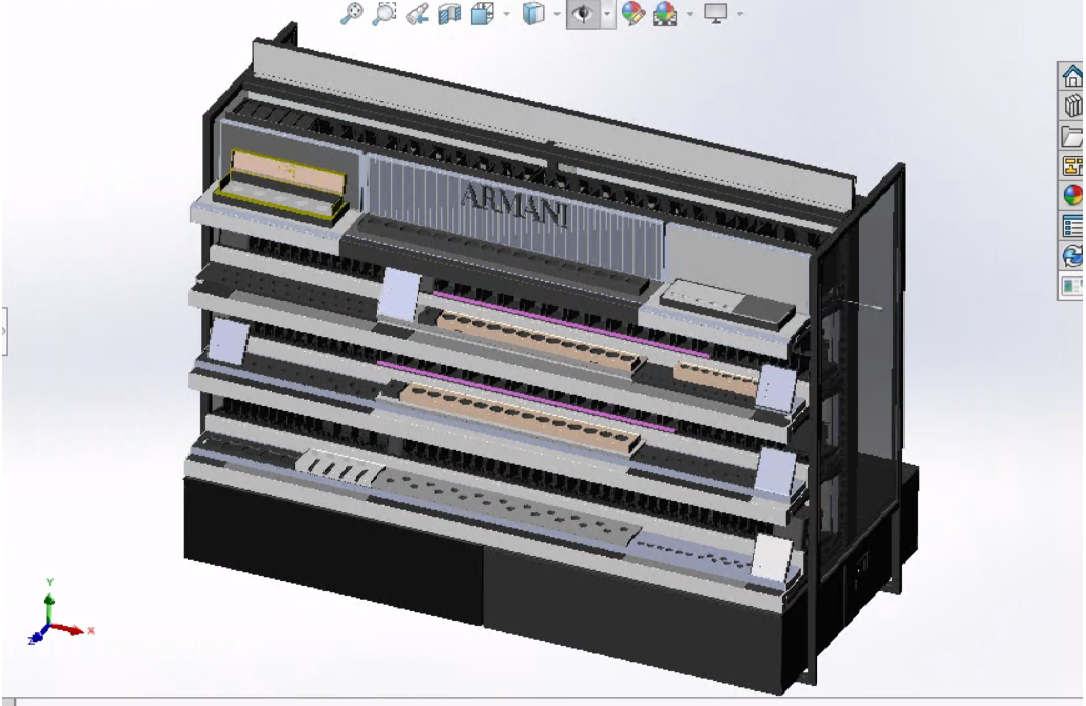
My core responsibility is designing 3D SolidWorks models of retail gondolas and display fixtures for multiple international brands. This involves building complete assemblies with proper fit, function, and manufacturability — ensuring that every component not only looks right but can be produced efficiently at scale.
Display fixtures combine a wide range of materials and manufacturing processes — sheet metal, wood, acrylics, and molded plastics — and each assembly must resolve structural integrity, brand aesthetics, and manufacturing cost simultaneously. Designs move through iterative reviews before release, with engineering decisions balancing what the brand wants against what the factory can build.
Manufacturing Documentation & Production Release
Every design is released to production through detailed technical drawings and manufacturing documentation. I prepare accurate Bills of Materials (BOMs) for procurement and production teams, and generate CNC-ready and nesting files for fabrication — ensuring material utilisation is optimised and all outputs comply with manufacturing standards.
Complete Engineering Production Packages (EPPs) consolidate the drawings, BOMs, and specifications that factories need to move from design intent to physical product. Managing this documentation for large-scale retail installations means maintaining precision across hundreds of components per project.
Vac-Form Components & Molded Parts
A specialised part of my role involves designing vacuum-formed (vac-form) components, molded parts, and template cavities based on project requirements. Vac-forming is widely used in retail displays for product trays, inserts, and contoured surfaces — and designing for this process requires understanding draft angles, material draw behaviour, and tooling constraints from the outset.
I also implement design type safeties for graphics quality across all deliverables — ensuring that printed and applied brand graphics maintain their integrity across every production unit.
Planograms & Brand Requirements
Retail displays exist to sell product, and product placement is engineered — not accidental. I develop planograms (POGs) that optimise display layouts and product placement, translating complex brand requirements into precise merchandising arrangements.
This is where engineering meets retail strategy: shelf spacing, product density, sight lines, and accessibility all feed into the planogram, which then drives the structural design of the fixture itself.
PDM & Product Lifecycle Management
I manage end-to-end engineering workflows for large-scale retail installations — from initial concept interpretation to mass production release. Version control of all 3D models is maintained through SolidWorks PDM, ensuring data integrity across concurrent projects and revisions.
Working within a structured PDM environment enforces disciplined engineering practice: every change is tracked, every revision is auditable, and released data is protected from uncontrolled modification.
Remote Collaboration & Prototyping
Working remotely with a Canada-based team requires deliberate, structured collaboration. I coordinate iterative design reviews with project management, quality control, and external stakeholders to prevent bottlenecks and keep projects moving across time zones.
On the prototyping side, I bridge the gap between design and manufacturing by partnering with the model shop to validate physical fit and function — executing rapid engineering fixes through correction reports when physical prototypes reveal issues that CAD cannot predict.